视觉SLAM十四讲从理论到实践第二版源码调试笔记(实践应用7-14章)

【摘要】
视觉SLAM十四讲从理论到实践第二版源码调试笔记(理论基础1-6章)
第七章和第八章:视觉里程计 1+2
使用示例,需要OpenCV4,报错如下:
ROS:~/SLAM/slambook2/ch8/build$ cmake ..-- The C compiler identification is GNU 7.4.0-- The CXX compi...
第七章和第八章:视觉里程计 1+2


使用示例,需要OpenCV4,报错如下:
-
ROS:~/SLAM/slambook2/ch8/build$ cmake ..
-
-- The C compiler identification is GNU 7.4.0
-
-- The CXX compiler identification is GNU 7.4.0
-
-- Check for working C compiler: /usr/bin/cc
-
-- Check for working C compiler: /usr/bin/cc -- works
-
-- Detecting C compiler ABI info
-
-- Detecting C compiler ABI info - done
-
-- Detecting C compile features
-
-- Detecting C compile features - done
-
-- Check for working CXX compiler: /usr/bin/c++
-
-- Check for working CXX compiler: /usr/bin/c++ -- works
-
-- Detecting CXX compiler ABI info
-
-- Detecting CXX compiler ABI info - done
-
-- Detecting CXX compile features
-
-- Detecting CXX compile features - done
-
CMake Error at CMakeLists.txt:8 (find_package):
-
Could not find a configuration file for package "OpenCV" that is compatible
-
with requested version "4".
-
-
The following configuration files were considered but not accepted:
-
-
/usr/share/OpenCV/OpenCVConfig.cmake, version: 3.2.0
-
-
-
-
-- Configuring incomplete, errors occurred!
-
See also "/home/relaybot/SLAM/slambook2/ch8/build/CMakeFiles/CMakeOutput.log".
安装OpenCV4参考:Ubuntu安装OpenCV4记录
-
ROS:~/SLAM/slambook2/ch8/build$ cmake ..
-
-- The C compiler identification is GNU 7.4.0
-
-- The CXX compiler identification is GNU 7.4.0
-
-- Check for working C compiler: /usr/bin/cc
-
-- Check for working C compiler: /usr/bin/cc -- works
-
-- Detecting C compiler ABI info
-
-- Detecting C compiler ABI info - done
-
-- Detecting C compile features
-
-- Detecting C compile features - done
-
-- Check for working CXX compiler: /usr/bin/c++
-
-- Check for working CXX compiler: /usr/bin/c++ -- works
-
-- Detecting CXX compiler ABI info
-
-- Detecting CXX compiler ABI info - done
-
-- Detecting CXX compile features
-
-- Detecting CXX compile features - done
-
-- Found OpenCV: /usr/local (found suitable version "4.1.2", minimum required is "4")
-
-- Configuring done
-
-- Generating done
-
-- Build files have been written to: /home/relaybot/SLAM/slambook2/ch8/build
-
ROS:~/SLAM/slambook2/ch8/build$ make
编译时如果报错,分别如下:
optical_flow.cpp:
-
$ make
-
Scanning dependencies of target optical_flow
-
[ 25%] Building CXX object CMakeFiles/optical_flow.dir/optical_flow.cpp.o
-
/home/relaybot/SLAM/slambook2/ch8/optical_flow.cpp: In function ‘int main(int, char**)’:
-
/home/relaybot/SLAM/slambook2/ch8/optical_flow.cpp:143:37: error: ‘CV_GRAY2BGR’ was not declared in this scope
-
cv::cvtColor(img2, img2_single, CV_GRAY2BGR);
-
^~~~~~~~~~~
-
CMakeFiles/optical_flow.dir/build.make:62: recipe for target 'CMakeFiles/optical_flow.dir/optical_flow.cpp.o' failed
-
make[2]: *** [CMakeFiles/optical_flow.dir/optical_flow.cpp.o] Error 1
-
CMakeFiles/Makefile2:67: recipe for target 'CMakeFiles/optical_flow.dir/all' failed
-
make[1]: *** [CMakeFiles/optical_flow.dir/all] Error 2
-
Makefile:83: recipe for target 'all' failed
-
make: *** [all] Error 2
将CV_GRAY2BGR,更新为COLOR_GRAY2BGR。
-
//
-
// Created by Xiang on 2017/12/19.
-
//
-
-
#include <opencv2/opencv.hpp>
-
#include <string>
-
#include <chrono>
-
#include <Eigen/Core>
-
#include <Eigen/Dense>
-
-
using namespace std;
-
using namespace cv;
-
-
string file_1 = "./LK1.png"; // first image
-
string file_2 = "./LK2.png"; // second image
-
-
/// Optical flow tracker and interface
-
class OpticalFlowTracker {
-
public:
-
OpticalFlowTracker(
-
const Mat &img1_,
-
const Mat &img2_,
-
const vector<KeyPoint> &kp1_,
-
vector<KeyPoint> &kp2_,
-
vector<bool> &success_,
-
bool inverse_ = true, bool has_initial_ = false) :
-
img1(img1_), img2(img2_), kp1(kp1_), kp2(kp2_), success(success_), inverse(inverse_),
-
has_initial(has_initial_) {}
-
-
void calculateOpticalFlow(const Range &range);
-
-
private:
-
const Mat &img1;
-
const Mat &img2;
-
const vector<KeyPoint> &kp1;
-
vector<KeyPoint> &kp2;
-
vector<bool> &success;
-
bool inverse = true;
-
bool has_initial = false;
-
};
-
-
/**
-
* single level optical flow
-
* @param [in] img1 the first image
-
* @param [in] img2 the second image
-
* @param [in] kp1 keypoints in img1
-
* @param [in|out] kp2 keypoints in img2, if empty, use initial guess in kp1
-
* @param [out] success true if a keypoint is tracked successfully
-
* @param [in] inverse use inverse formulation?
-
*/
-
void OpticalFlowSingleLevel(
-
const Mat &img1,
-
const Mat &img2,
-
const vector<KeyPoint> &kp1,
-
vector<KeyPoint> &kp2,
-
vector<bool> &success,
-
bool inverse = false,
-
bool has_initial_guess = false
-
);
-
-
/**
-
* multi level optical flow, scale of pyramid is set to 2 by default
-
* the image pyramid will be create inside the function
-
* @param [in] img1 the first pyramid
-
* @param [in] img2 the second pyramid
-
* @param [in] kp1 keypoints in img1
-
* @param [out] kp2 keypoints in img2
-
* @param [out] success true if a keypoint is tracked successfully
-
* @param [in] inverse set true to enable inverse formulation
-
*/
-
void OpticalFlowMultiLevel(
-
const Mat &img1,
-
const Mat &img2,
-
const vector<KeyPoint> &kp1,
-
vector<KeyPoint> &kp2,
-
vector<bool> &success,
-
bool inverse = false
-
);
-
-
/**
-
* get a gray scale value from reference image (bi-linear interpolated)
-
* @param img
-
* @param x
-
* @param y
-
* @return the interpolated value of this pixel
-
*/
-
inline float GetPixelValue(const cv::Mat &img, float x, float y) {
-
// boundary check
-
if (x < 0) x = 0;
-
if (y < 0) y = 0;
-
if (x >= img.cols) x = img.cols - 1;
-
if (y >= img.rows) y = img.rows - 1;
-
uchar *data = &img.data[int(y) * img.step + int(x)];
-
float xx = x - floor(x);
-
float yy = y - floor(y);
-
return float(
-
(1 - xx) * (1 - yy) * data[0] +
-
xx * (1 - yy) * data[1] +
-
(1 - xx) * yy * data[img.step] +
-
xx * yy * data[img.step + 1]
-
);
-
}
-
-
int main(int argc, char **argv) {
-
-
// images, note they are CV_8UC1, not CV_8UC3
-
Mat img1 = imread(file_1, 0);
-
Mat img2 = imread(file_2, 0);
-
-
// key points, using GFTT here.
-
vector<KeyPoint> kp1;
-
Ptr<GFTTDetector> detector = GFTTDetector::create(500, 0.01, 20); // maximum 500 keypoints
-
detector->detect(img1, kp1);
-
-
// now lets track these key points in the second image
-
// first use single level LK in the validation picture
-
vector<KeyPoint> kp2_single;
-
vector<bool> success_single;
-
OpticalFlowSingleLevel(img1, img2, kp1, kp2_single, success_single);
-
-
// then test multi-level LK
-
vector<KeyPoint> kp2_multi;
-
vector<bool> success_multi;
-
chrono::steady_clock::time_point t1 = chrono::steady_clock::now();
-
OpticalFlowMultiLevel(img1, img2, kp1, kp2_multi, success_multi, true);
-
chrono::steady_clock::time_point t2 = chrono::steady_clock::now();
-
auto time_used = chrono::duration_cast<chrono::duration<double>>(t2 - t1);
-
cout << "optical flow by gauss-newton: " << time_used.count() << endl;
-
-
// use opencv's flow for validation
-
vector<Point2f> pt1, pt2;
-
for (auto &kp: kp1) pt1.push_back(kp.pt);
-
vector<uchar> status;
-
vector<float> error;
-
t1 = chrono::steady_clock::now();
-
cv::calcOpticalFlowPyrLK(img1, img2, pt1, pt2, status, error);
-
t2 = chrono::steady_clock::now();
-
time_used = chrono::duration_cast<chrono::duration<double>>(t2 - t1);
-
cout << "optical flow by opencv: " << time_used.count() << endl;
-
-
// plot the differences of those functions
-
Mat img2_single;
-
cv::cvtColor(img2, img2_single, COLOR_GRAY2BGR);
-
for (int i = 0; i < kp2_single.size(); i++) {
-
if (success_single[i]) {
-
cv::circle(img2_single, kp2_single[i].pt, 2, cv::Scalar(0, 250, 0), 2);
-
cv::line(img2_single, kp1[i].pt, kp2_single[i].pt, cv::Scalar(0, 250, 0));
-
}
-
}
-
-
Mat img2_multi;
-
cv::cvtColor(img2, img2_multi, COLOR_GRAY2BGR);
-
for (int i = 0; i < kp2_multi.size(); i++) {
-
if (success_multi[i]) {
-
cv::circle(img2_multi, kp2_multi[i].pt, 2, cv::Scalar(0, 250, 0), 2);
-
cv::line(img2_multi, kp1[i].pt, kp2_multi[i].pt, cv::Scalar(0, 250, 0));
-
}
-
}
-
-
Mat img2_CV;
-
cv::cvtColor(img2, img2_CV, COLOR_GRAY2BGR);
-
for (int i = 0; i < pt2.size(); i++) {
-
if (status[i]) {
-
cv::circle(img2_CV, pt2[i], 2, cv::Scalar(0, 250, 0), 2);
-
cv::line(img2_CV, pt1[i], pt2[i], cv::Scalar(0, 250, 0));
-
}
-
}
-
-
cv::imshow("tracked single level", img2_single);
-
cv::imshow("tracked multi level", img2_multi);
-
cv::imshow("tracked by opencv", img2_CV);
-
cv::waitKey(0);
-
-
return 0;
-
}
-
-
void OpticalFlowSingleLevel(
-
const Mat &img1,
-
const Mat &img2,
-
const vector<KeyPoint> &kp1,
-
vector<KeyPoint> &kp2,
-
vector<bool> &success,
-
bool inverse, bool has_initial) {
-
kp2.resize(kp1.size());
-
success.resize(kp1.size());
-
OpticalFlowTracker tracker(img1, img2, kp1, kp2, success, inverse, has_initial);
-
parallel_for_(Range(0, kp1.size()),
-
std::bind(&OpticalFlowTracker::calculateOpticalFlow, &tracker, placeholders::_1));
-
}
-
-
void OpticalFlowTracker::calculateOpticalFlow(const Range &range) {
-
// parameters
-
int half_patch_size = 4;
-
int iterations = 10;
-
for (size_t i = range.start; i < range.end; i++) {
-
auto kp = kp1[i];
-
double dx = 0, dy = 0; // dx,dy need to be estimated
-
if (has_initial) {
-
dx = kp2[i].pt.x - kp.pt.x;
-
dy = kp2[i].pt.y - kp.pt.y;
-
}
-
-
double cost = 0, lastCost = 0;
-
bool succ = true; // indicate if this point succeeded
-
-
// Gauss-Newton iterations
-
Eigen::Matrix2d H = Eigen::Matrix2d::Zero(); // hessian
-
Eigen::Vector2d b = Eigen::Vector2d::Zero(); // bias
-
Eigen::Vector2d J; // jacobian
-
for (int iter = 0; iter < iterations; iter++) {
-
if (inverse == false) {
-
H = Eigen::Matrix2d::Zero();
-
b = Eigen::Vector2d::Zero();
-
} else {
-
// only reset b
-
b = Eigen::Vector2d::Zero();
-
}
-
-
cost = 0;
-
-
// compute cost and jacobian
-
for (int x = -half_patch_size; x < half_patch_size; x++)
-
for (int y = -half_patch_size; y < half_patch_size; y++) {
-
double error = GetPixelValue(img1, kp.pt.x + x, kp.pt.y + y) -
-
GetPixelValue(img2, kp.pt.x + x + dx, kp.pt.y + y + dy);; // Jacobian
-
if (inverse == false) {
-
J = -1.0 * Eigen::Vector2d(
-
0.5 * (GetPixelValue(img2, kp.pt.x + dx + x + 1, kp.pt.y + dy + y) -
-
GetPixelValue(img2, kp.pt.x + dx + x - 1, kp.pt.y + dy + y)),
-
0.5 * (GetPixelValue(img2, kp.pt.x + dx + x, kp.pt.y + dy + y + 1) -
-
GetPixelValue(img2, kp.pt.x + dx + x, kp.pt.y + dy + y - 1))
-
);
-
} else if (iter == 0) {
-
// in inverse mode, J keeps same for all iterations
-
// NOTE this J does not change when dx, dy is updated, so we can store it and only compute error
-
J = -1.0 * Eigen::Vector2d(
-
0.5 * (GetPixelValue(img1, kp.pt.x + x + 1, kp.pt.y + y) -
-
GetPixelValue(img1, kp.pt.x + x - 1, kp.pt.y + y)),
-
0.5 * (GetPixelValue(img1, kp.pt.x + x, kp.pt.y + y + 1) -
-
GetPixelValue(img1, kp.pt.x + x, kp.pt.y + y - 1))
-
);
-
}
-
// compute H, b and set cost;
-
b += -error * J;
-
cost += error * error;
-
if (inverse == false || iter == 0) {
-
// also update H
-
H += J * J.transpose();
-
}
-
}
-
-
// compute update
-
Eigen::Vector2d update = H.ldlt().solve(b);
-
-
if (std::isnan(update[0])) {
-
// sometimes occurred when we have a black or white patch and H is irreversible
-
cout << "update is nan" << endl;
-
succ = false;
-
break;
-
}
-
-
if (iter > 0 && cost > lastCost) {
-
break;
-
}
-
-
// update dx, dy
-
dx += update[0];
-
dy += update[1];
-
lastCost = cost;
-
succ = true;
-
-
if (update.norm() < 1e-2) {
-
// converge
-
break;
-
}
-
}
-
-
success[i] = succ;
-
-
// set kp2
-
kp2[i].pt = kp.pt + Point2f(dx, dy);
-
}
-
}
-
-
void OpticalFlowMultiLevel(
-
const Mat &img1,
-
const Mat &img2,
-
const vector<KeyPoint> &kp1,
-
vector<KeyPoint> &kp2,
-
vector<bool> &success,
-
bool inverse) {
-
-
// parameters
-
int pyramids = 4;
-
double pyramid_scale = 0.5;
-
double scales[] = {1.0, 0.5, 0.25, 0.125};
-
-
// create pyramids
-
chrono::steady_clock::time_point t1 = chrono::steady_clock::now();
-
vector<Mat> pyr1, pyr2; // image pyramids
-
for (int i = 0; i < pyramids; i++) {
-
if (i == 0) {
-
pyr1.push_back(img1);
-
pyr2.push_back(img2);
-
} else {
-
Mat img1_pyr, img2_pyr;
-
cv::resize(pyr1[i - 1], img1_pyr,
-
cv::Size(pyr1[i - 1].cols * pyramid_scale, pyr1[i - 1].rows * pyramid_scale));
-
cv::resize(pyr2[i - 1], img2_pyr,
-
cv::Size(pyr2[i - 1].cols * pyramid_scale, pyr2[i - 1].rows * pyramid_scale));
-
pyr1.push_back(img1_pyr);
-
pyr2.push_back(img2_pyr);
-
}
-
}
-
chrono::steady_clock::time_point t2 = chrono::steady_clock::now();
-
auto time_used = chrono::duration_cast<chrono::duration<double>>(t2 - t1);
-
cout << "build pyramid time: " << time_used.count() << endl;
-
-
// coarse-to-fine LK tracking in pyramids
-
vector<KeyPoint> kp1_pyr, kp2_pyr;
-
for (auto &kp:kp1) {
-
auto kp_top = kp;
-
kp_top.pt *= scales[pyramids - 1];
-
kp1_pyr.push_back(kp_top);
-
kp2_pyr.push_back(kp_top);
-
}
-
-
for (int level = pyramids - 1; level >= 0; level--) {
-
// from coarse to fine
-
success.clear();
-
t1 = chrono::steady_clock::now();
-
OpticalFlowSingleLevel(pyr1[level], pyr2[level], kp1_pyr, kp2_pyr, success, inverse, true);
-
t2 = chrono::steady_clock::now();
-
auto time_used = chrono::duration_cast<chrono::duration<double>>(t2 - t1);
-
cout << "track pyr " << level << " cost time: " << time_used.count() << endl;
-
-
if (level > 0) {
-
for (auto &kp: kp1_pyr)
-
kp.pt /= pyramid_scale;
-
for (auto &kp: kp2_pyr)
-
kp.pt /= pyramid_scale;
-
}
-
}
-
-
for (auto &kp: kp2_pyr)
-
kp2.push_back(kp);
-
}
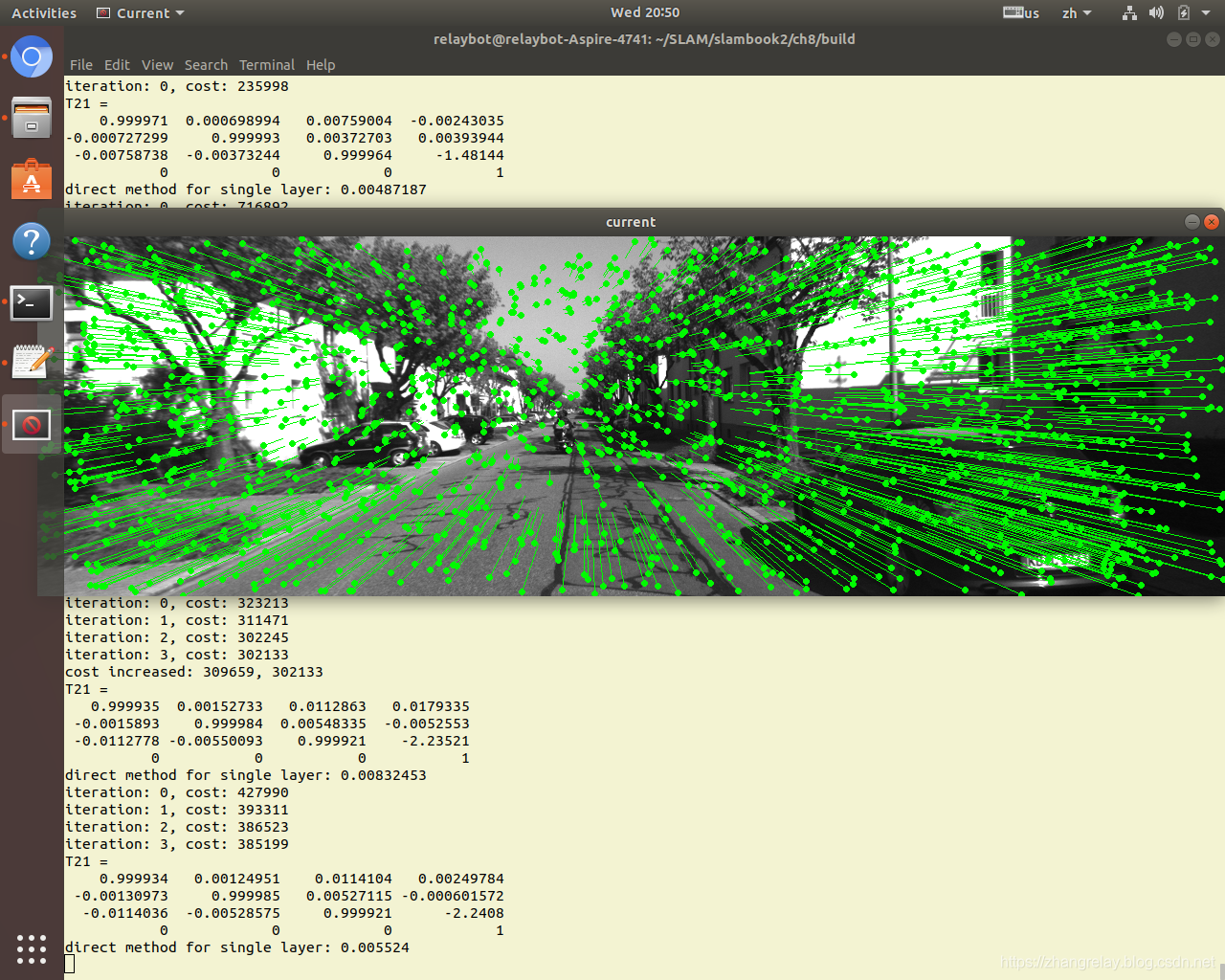
但是,direct_method.cpp依然报错,如下:
-
make
-
[ 50%] Built target optical_flow
-
Scanning dependencies of target direct_method
-
[ 75%] Building CXX object CMakeFiles/direct_method.dir/direct_method.cpp.o
-
/home/relaybot/SLAM/slambook2/ch8/direct_method.cpp: In function ‘void DirectPoseEstimationSingleLayer(const cv::Mat&, const cv::Mat&, const VecVector2d&, std::vector<double, std::allocator<double> >, Sophus::SE3d&)’:
-
/home/relaybot/SLAM/slambook2/ch8/direct_method.cpp:206:35: error: ‘COLOR_GRAY2BGR’ was not declared in this scope
-
cv::cvtColor(img2, img2_show, COLOR_GRAY2BGR);
-
^~~~~~~~~~~~~~
-
/home/relaybot/SLAM/slambook2/ch8/direct_method.cpp:206:35: note: suggested alternative:
-
In file included from /usr/local/include/opencv4/opencv2/opencv.hpp:74:0,
-
from /home/relaybot/SLAM/slambook2/ch8/direct_method.cpp:1:
-
/usr/local/include/opencv4/opencv2/imgproc.hpp:542:5: note: ‘COLOR_GRAY2BGR’
-
COLOR_GRAY2BGR = 8,
-
^~~~~~~~~~~~~~
-
CMakeFiles/direct_method.dir/build.make:62: recipe for target 'CMakeFiles/direct_method.dir/direct_method.cpp.o' failed
-
make[2]: *** [CMakeFiles/direct_method.dir/direct_method.cpp.o] Error 1
-
CMakeFiles/Makefile2:104: recipe for target 'CMakeFiles/direct_method.dir/all' failed
-
make[1]: *** [CMakeFiles/direct_method.dir/all] Error 2
-
Makefile:83: recipe for target 'all' failed
-
make: *** [all] Error 2
在程序中,添加using namespace cv;
修正后的程序如下:
-
#include <opencv2/opencv.hpp>
-
#include <sophus/se3.hpp>
-
#include <boost/format.hpp>
-
#include <pangolin/pangolin.h>
-
-
using namespace std;
-
using namespace cv;
-
-
typedef vector<Eigen::Vector2d, Eigen::aligned_allocator<Eigen::Vector2d>> VecVector2d;
-
-
// Camera intrinsics
-
double fx = 718.856, fy = 718.856, cx = 607.1928, cy = 185.2157;
-
// baseline
-
double baseline = 0.573;
-
// paths
-
string left_file = "./left.png";
-
string disparity_file = "./disparity.png";
-
boost::format fmt_others("./%06d.png"); // other files
-
-
// useful typedefs
-
typedef Eigen::Matrix<double, 6, 6> Matrix6d;
-
typedef Eigen::Matrix<double, 2, 6> Matrix26d;
-
typedef Eigen::Matrix<double, 6, 1> Vector6d;
-
-
/// class for accumulator jacobians in parallel
-
class JacobianAccumulator {
-
public:
-
JacobianAccumulator(
-
const cv::Mat &img1_,
-
const cv::Mat &img2_,
-
const VecVector2d &px_ref_,
-
const vector<double> depth_ref_,
-
Sophus::SE3d &T21_) :
-
img1(img1_), img2(img2_), px_ref(px_ref_), depth_ref(depth_ref_), T21(T21_) {
-
projection = VecVector2d(px_ref.size(), Eigen::Vector2d(0, 0));
-
}
-
-
/// accumulate jacobians in a range
-
void accumulate_jacobian(const cv::Range &range);
-
-
/// get hessian matrix
-
Matrix6d hessian() const { return H; }
-
-
/// get bias
-
Vector6d bias() const { return b; }
-
-
/// get total cost
-
double cost_func() const { return cost; }
-
-
/// get projected points
-
VecVector2d projected_points() const { return projection; }
-
-
/// reset h, b, cost to zero
-
void reset() {
-
H = Matrix6d::Zero();
-
b = Vector6d::Zero();
-
cost = 0;
-
}
-
-
private:
-
const cv::Mat &img1;
-
const cv::Mat &img2;
-
const VecVector2d &px_ref;
-
const vector<double> depth_ref;
-
Sophus::SE3d &T21;
-
VecVector2d projection; // projected points
-
-
std::mutex hessian_mutex;
-
Matrix6d H = Matrix6d::Zero();
-
Vector6d b = Vector6d::Zero();
-
double cost = 0;
-
};
-
-
/**
-
* pose estimation using direct method
-
* @param img1
-
* @param img2
-
* @param px_ref
-
* @param depth_ref
-
* @param T21
-
*/
-
void DirectPoseEstimationMultiLayer(
-
const cv::Mat &img1,
-
const cv::Mat &img2,
-
const VecVector2d &px_ref,
-
const vector<double> depth_ref,
-
Sophus::SE3d &T21
-
);
-
-
/**
-
* pose estimation using direct method
-
* @param img1
-
* @param img2
-
* @param px_ref
-
* @param depth_ref
-
* @param T21
-
*/
-
void DirectPoseEstimationSingleLayer(
-
const cv::Mat &img1,
-
const cv::Mat &img2,
-
const VecVector2d &px_ref,
-
const vector<double> depth_ref,
-
Sophus::SE3d &T21
-
);
-
-
// bilinear interpolation
-
inline float GetPixelValue(const cv::Mat &img, float x, float y) {
-
// boundary check
-
if (x < 0) x = 0;
-
if (y < 0) y = 0;
-
if (x >= img.cols) x = img.cols - 1;
-
if (y >= img.rows) y = img.rows - 1;
-
uchar *data = &img.data[int(y) * img.step + int(x)];
-
float xx = x - floor(x);
-
float yy = y - floor(y);
-
return float(
-
(1 - xx) * (1 - yy) * data[0] +
-
xx * (1 - yy) * data[1] +
-
(1 - xx) * yy * data[img.step] +
-
xx * yy * data[img.step + 1]
-
);
-
}
-
-
int main(int argc, char **argv) {
-
-
cv::Mat left_img = cv::imread(left_file, 0);
-
cv::Mat disparity_img = cv::imread(disparity_file, 0);
-
-
// let's randomly pick pixels in the first image and generate some 3d points in the first image's frame
-
cv::RNG rng;
-
int nPoints = 2000;
-
int boarder = 20;
-
VecVector2d pixels_ref;
-
vector<double> depth_ref;
-
-
// generate pixels in ref and load depth data
-
for (int i = 0; i < nPoints; i++) {
-
int x = rng.uniform(boarder, left_img.cols - boarder); // don't pick pixels close to boarder
-
int y = rng.uniform(boarder, left_img.rows - boarder); // don't pick pixels close to boarder
-
int disparity = disparity_img.at<uchar>(y, x);
-
double depth = fx * baseline / disparity; // you know this is disparity to depth
-
depth_ref.push_back(depth);
-
pixels_ref.push_back(Eigen::Vector2d(x, y));
-
}
-
-
// estimates 01~05.png's pose using this information
-
Sophus::SE3d T_cur_ref;
-
-
for (int i = 1; i < 6; i++) { // 1~10
-
cv::Mat img = cv::imread((fmt_others % i).str(), 0);
-
// try single layer by uncomment this line
-
// DirectPoseEstimationSingleLayer(left_img, img, pixels_ref, depth_ref, T_cur_ref);
-
DirectPoseEstimationMultiLayer(left_img, img, pixels_ref, depth_ref, T_cur_ref);
-
}
-
return 0;
-
}
-
-
void DirectPoseEstimationSingleLayer(
-
const cv::Mat &img1,
-
const cv::Mat &img2,
-
const VecVector2d &px_ref,
-
const vector<double> depth_ref,
-
Sophus::SE3d &T21) {
-
-
const int iterations = 10;
-
double cost = 0, lastCost = 0;
-
auto t1 = chrono::steady_clock::now();
-
JacobianAccumulator jaco_accu(img1, img2, px_ref, depth_ref, T21);
-
-
for (int iter = 0; iter < iterations; iter++) {
-
jaco_accu.reset();
-
cv::parallel_for_(cv::Range(0, px_ref.size()),
-
std::bind(&JacobianAccumulator::accumulate_jacobian, &jaco_accu, std::placeholders::_1));
-
Matrix6d H = jaco_accu.hessian();
-
Vector6d b = jaco_accu.bias();
-
-
// solve update and put it into estimation
-
Vector6d update = H.ldlt().solve(b);;
-
T21 = Sophus::SE3d::exp(update) * T21;
-
cost = jaco_accu.cost_func();
-
-
if (std::isnan(update[0])) {
-
// sometimes occurred when we have a black or white patch and H is irreversible
-
cout << "update is nan" << endl;
-
break;
-
}
-
if (iter > 0 && cost > lastCost) {
-
cout << "cost increased: " << cost << ", " << lastCost << endl;
-
break;
-
}
-
if (update.norm() < 1e-3) {
-
// converge
-
break;
-
}
-
-
lastCost = cost;
-
cout << "iteration: " << iter << ", cost: " << cost << endl;
-
}
-
-
cout << "T21 = \n" << T21.matrix() << endl;
-
auto t2 = chrono::steady_clock::now();
-
auto time_used = chrono::duration_cast<chrono::duration<double>>(t2 - t1);
-
cout << "direct method for single layer: " << time_used.count() << endl;
-
-
// plot the projected pixels here
-
cv::Mat img2_show;
-
//Mat img2_show;
-
cv::cvtColor(img2, img2_show, COLOR_GRAY2BGR);
-
VecVector2d projection = jaco_accu.projected_points();
-
for (size_t i = 0; i < px_ref.size(); ++i) {
-
auto p_ref = px_ref[i];
-
auto p_cur = projection[i];
-
if (p_cur[0] > 0 && p_cur[1] > 0) {
-
cv::circle(img2_show, cv::Point2f(p_cur[0], p_cur[1]), 2, cv::Scalar(0, 250, 0), 2);
-
cv::line(img2_show, cv::Point2f(p_ref[0], p_ref[1]), cv::Point2f(p_cur[0], p_cur[1]),
-
cv::Scalar(0, 250, 0));
-
}
-
}
-
cv::imshow("current", img2_show);
-
cv::waitKey();
-
}
-
-
void JacobianAccumulator::accumulate_jacobian(const cv::Range &range) {
-
-
// parameters
-
const int half_patch_size = 1;
-
int cnt_good = 0;
-
Matrix6d hessian = Matrix6d::Zero();
-
Vector6d bias = Vector6d::Zero();
-
double cost_tmp = 0;
-
-
for (size_t i = range.start; i < range.end; i++) {
-
-
// compute the projection in the second image
-
Eigen::Vector3d point_ref =
-
depth_ref[i] * Eigen::Vector3d((px_ref[i][0] - cx) / fx, (px_ref[i][1] - cy) / fy, 1);
-
Eigen::Vector3d point_cur = T21 * point_ref;
-
if (point_cur[2] < 0) // depth invalid
-
continue;
-
-
float u = fx * point_cur[0] / point_cur[2] + cx, v = fy * point_cur[1] / point_cur[2] + cy;
-
if (u < half_patch_size || u > img2.cols - half_patch_size || v < half_patch_size ||
-
v > img2.rows - half_patch_size)
-
continue;
-
-
projection[i] = Eigen::Vector2d(u, v);
-
double X = point_cur[0], Y = point_cur[1], Z = point_cur[2],
-
Z2 = Z * Z, Z_inv = 1.0 / Z, Z2_inv = Z_inv * Z_inv;
-
cnt_good++;
-
-
// and compute error and jacobian
-
for (int x = -half_patch_size; x <= half_patch_size; x++)
-
for (int y = -half_patch_size; y <= half_patch_size; y++) {
-
-
double error = GetPixelValue(img1, px_ref[i][0] + x, px_ref[i][1] + y) -
-
GetPixelValue(img2, u + x, v + y);
-
Matrix26d J_pixel_xi;
-
Eigen::Vector2d J_img_pixel;
-
-
J_pixel_xi(0, 0) = fx * Z_inv;
-
J_pixel_xi(0, 1) = 0;
-
J_pixel_xi(0, 2) = -fx * X * Z2_inv;
-
J_pixel_xi(0, 3) = -fx * X * Y * Z2_inv;
-
J_pixel_xi(0, 4) = fx + fx * X * X * Z2_inv;
-
J_pixel_xi(0, 5) = -fx * Y * Z_inv;
-
-
J_pixel_xi(1, 0) = 0;
-
J_pixel_xi(1, 1) = fy * Z_inv;
-
J_pixel_xi(1, 2) = -fy * Y * Z2_inv;
-
J_pixel_xi(1, 3) = -fy - fy * Y * Y * Z2_inv;
-
J_pixel_xi(1, 4) = fy * X * Y * Z2_inv;
-
J_pixel_xi(1, 5) = fy * X * Z_inv;
-
-
J_img_pixel = Eigen::Vector2d(
-
0.5 * (GetPixelValue(img2, u + 1 + x, v + y) - GetPixelValue(img2, u - 1 + x, v + y)),
-
0.5 * (GetPixelValue(img2, u + x, v + 1 + y) - GetPixelValue(img2, u + x, v - 1 + y))
-
);
-
-
// total jacobian
-
Vector6d J = -1.0 * (J_img_pixel.transpose() * J_pixel_xi).transpose();
-
-
hessian += J * J.transpose();
-
bias += -error * J;
-
cost_tmp += error * error;
-
}
-
}
-
-
if (cnt_good) {
-
// set hessian, bias and cost
-
unique_lock<mutex> lck(hessian_mutex);
-
H += hessian;
-
b += bias;
-
cost += cost_tmp / cnt_good;
-
}
-
}
-
-
void DirectPoseEstimationMultiLayer(
-
const cv::Mat &img1,
-
const cv::Mat &img2,
-
const VecVector2d &px_ref,
-
const vector<double> depth_ref,
-
Sophus::SE3d &T21) {
-
-
// parameters
-
int pyramids = 4;
-
double pyramid_scale = 0.5;
-
double scales[] = {1.0, 0.5, 0.25, 0.125};
-
-
// create pyramids
-
vector<cv::Mat> pyr1, pyr2; // image pyramids
-
for (int i = 0; i < pyramids; i++) {
-
if (i == 0) {
-
pyr1.push_back(img1);
-
pyr2.push_back(img2);
-
} else {
-
cv::Mat img1_pyr, img2_pyr;
-
cv::resize(pyr1[i - 1], img1_pyr,
-
cv::Size(pyr1[i - 1].cols * pyramid_scale, pyr1[i - 1].rows * pyramid_scale));
-
cv::resize(pyr2[i - 1], img2_pyr,
-
cv::Size(pyr2[i - 1].cols * pyramid_scale, pyr2[i - 1].rows * pyramid_scale));
-
pyr1.push_back(img1_pyr);
-
pyr2.push_back(img2_pyr);
-
}
-
}
-
-
double fxG = fx, fyG = fy, cxG = cx, cyG = cy; // backup the old values
-
for (int level = pyramids - 1; level >= 0; level--) {
-
VecVector2d px_ref_pyr; // set the keypoints in this pyramid level
-
for (auto &px: px_ref) {
-
px_ref_pyr.push_back(scales[level] * px);
-
}
-
-
// scale fx, fy, cx, cy in different pyramid levels
-
fx = fxG * scales[level];
-
fy = fyG * scales[level];
-
cx = cxG * scales[level];
-
cy = cyG * scales[level];
-
DirectPoseEstimationSingleLayer(pyr1[level], pyr2[level], px_ref_pyr, depth_ref, T21);
-
}
-
-
}

第九章和第十章:后端 1+2
编译示例,不会遇到问题。

第十一章:回环检测
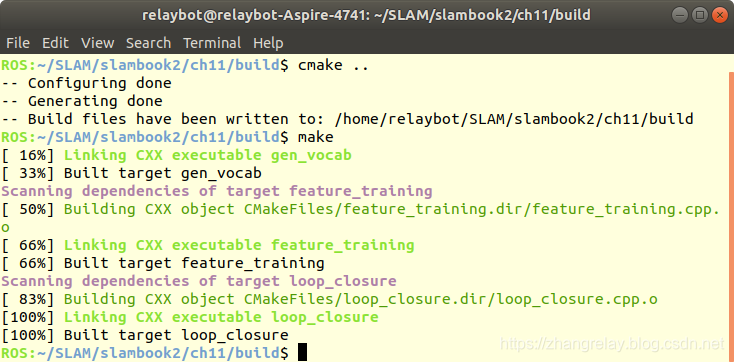
需要先编译第三方功能包:DBoW3。
然后再编译时候,可能出错,信息如下:
-
ROS:~/SLAM/slambook2/ch11/build$ make
-
Scanning dependencies of target gen_vocab
-
[ 16%] Building CXX object CMakeFiles/gen_vocab.dir/gen_vocab_large.cpp.o
-
make[2]: *** No rule to make target '/usr/local/lib/libDBoW3.a', needed by 'gen_vocab'. Stop.
-
CMakeFiles/Makefile2:67: recipe for target 'CMakeFiles/gen_vocab.dir/all' failed
-
make[1]: *** [CMakeFiles/gen_vocab.dir/all] Error 2
-
Makefile:83: recipe for target 'all' failed
-
make: *** [all] Error 2
原因:
看一下~/slambook2/ch11/CMakeLists.txt,发现如下:
-
# dbow3
-
# dbow3 is a simple lib so I assume you installed it in default directory
-
set( DBoW3_INCLUDE_DIRS "/usr/local/include" )
-
set( DBoW3_LIBS "/usr/local/lib/libDBoW3.a" )
实际是:
-
ROS:~/SLAM/slambook2/3rdparty/DBoW3/build$ sudo make install
-
[sudo] password for relaybot:
-
[ 60%] Built target DBoW3
-
[ 73%] Built target create_voc_step0
-
[ 86%] Built target demo_general
-
[100%] Built target create_voc_step1
-
Install the project...
-
-- Install configuration: "Release"
-
-- Installing: /usr/local/lib/cmake/FindDBoW3.cmake
-
-- Installing: /usr/local/lib/cmake/DBoW3/DBoW3Config.cmake
-
-- Installing: /usr/local/lib/libDBoW3.so.0.0.1
-
-- Installing: /usr/local/lib/libDBoW3.so.0.0
-
-- Installing: /usr/local/lib/libDBoW3.so
-
-- Installing: /usr/local/include/DBoW3/BowVector.h
-
-- Installing: /usr/local/include/DBoW3/DBoW3.h
-
-- Installing: /usr/local/include/DBoW3/Database.h
-
-- Installing: /usr/local/include/DBoW3/DescManip.h
-
-- Installing: /usr/local/include/DBoW3/FeatureVector.h
-
-- Installing: /usr/local/include/DBoW3/QueryResults.h
-
-- Installing: /usr/local/include/DBoW3/ScoringObject.h
-
-- Installing: /usr/local/include/DBoW3/Vocabulary.h
-
-- Installing: /usr/local/include/DBoW3/exports.h
-
-- Installing: /usr/local/include/DBoW3/quicklz.h
-
-- Installing: /usr/local/include/DBoW3/timers.h
-
-- Installing: /usr/local/bin/demo_general
-
-- Set runtime path of "/usr/local/bin/demo_general" to ""
-
-- Installing: /usr/local/bin/create_voc_step0
-
-- Set runtime path of "/usr/local/bin/create_voc_step0" to ""
-
-- Installing: /usr/local/bin/create_voc_step1
-
-- Set runtime path of "/usr/local/bin/create_voc_step1" to ""
将/usr/local/lib/libDBoW3.a改为/usr/local/lib/libDBoW3.so!!!
然后就一切ok。
第十二章:建图
正常编译,一切ok!
第十三章:实践:设计SLAM系统
需要先编译3rdparty/googletest,否则会报如下错误:
-
ROS:~/SLAM/slambook2/ch13/build$ cmake ..
-
-- The C compiler identification is GNU 7.4.0
-
-- The CXX compiler identification is GNU 7.4.0
-
-- Check for working C compiler: /usr/bin/cc
-
-- Check for working C compiler: /usr/bin/cc -- works
-
-- Detecting C compiler ABI info
-
-- Detecting C compiler ABI info - done
-
-- Detecting C compile features
-
-- Detecting C compile features - done
-
-- Check for working CXX compiler: /usr/bin/c++
-
-- Check for working CXX compiler: /usr/bin/c++ -- works
-
-- Detecting CXX compiler ABI info
-
-- Detecting CXX compiler ABI info - done
-
-- Detecting CXX compile features
-
-- Detecting CXX compile features - done
-
-- Found OpenCV: /usr (found suitable version "3.2.0", minimum required is "3.1")
-
-- Found Glog: /usr/include
-
CMake Error at /usr/share/cmake-3.10/Modules/FindPackageHandleStandardArgs.cmake:137 (message):
-
Could NOT find GTest (missing: GTEST_LIBRARY GTEST_MAIN_LIBRARY)
-
Call Stack (most recent call first):
-
/usr/share/cmake-3.10/Modules/FindPackageHandleStandardArgs.cmake:378 (_FPHSA_FAILURE_MESSAGE)
-
/usr/share/cmake-3.10/Modules/FindGTest.cmake:196 (FIND_PACKAGE_HANDLE_STANDARD_ARGS)
-
CMakeLists.txt:38 (find_package)
-
-
-
-- Configuring incomplete, errors occurred!
-
See also "/home/relaybot/SLAM/slambook2/ch13/build/CMakeFiles/CMakeOutput.log"
安装好googletest,就一切正常了。
第十四章:SLAM:现在与未来
自学各种SLAM案例,推荐一个网址:OpenSLAM!

附录A和附录B为数学基础,必须掌握
附录C~ROS入门:参考之前一篇博文如下:
这只是将全书案例在自己电脑上复现的过程,重点是:
SLAM理论和实践!!!
SLAM理论和实践!!!
SLAM理论和实践!!!
每章具体备课内容,在开课前更新。
文章来源: zhangrelay.blog.csdn.net,作者:zhangrelay,版权归原作者所有,如需转载,请联系作者。
原文链接:zhangrelay.blog.csdn.net/article/details/103169383

【版权声明】本文为华为云社区用户转载文章,如果您发现本社区中有涉嫌抄袭的内容,欢迎发送邮件进行举报,并提供相关证据,一经查实,本社区将立刻删除涉嫌侵权内容,举报邮箱:
cloudbbs@huaweicloud.com
- 点赞
- 收藏
- 关注作者
评论(0)