2026-05-13:单词方块Ⅱ。用go语言,给定一个由互不相同小写字母组成的四字母字符串列表 words。我们要从中找出“单词

2026-05-13:单词方块Ⅱ。用go语言,给定一个由互不相同小写字母组成的四字母字符串列表 words。我们要从中找出“单词方块”四个单词 top、left、right、bottom(全部不同),并满足它们在字母位置上的对应关系:
-
top 的第 1 个字母(索引 0)必须等于 left 的第 1 个字母(索引 0)
-
top 的第 4 个字母(索引 3)必须等于 right 的第 1 个字母(索引 0)
-
bottom 的第 1 个字母(索引 0)必须等于 left 的第 4 个字母(索引 3)
-
bottom 的第 4 个字母(索引 3)必须等于 right 的第 4 个字母(索引 3)
也就是说,这四个单词的首尾字母要在“上/下行、左/右列”四个角点位置严格匹配,从而形成满足条件的方块。
要求输出所有不同的满足条件的方块,并按字典序对 4 元组 (top, left, right, bottom) 做升序排序后返回。
4 <= words.length <= 15。
words[i].length == 4。
words[i] 仅由小写英文字母组成。
所有 words[i] 都 互不相同 。
输入: words = [“able”,“area”,“echo”,“also”]。
输出: [[“able”,“area”,“echo”,“also”],[“area”,“able”,“also”,“echo”]]。
解释:
有且仅有两个符合题目要求的四字母单词方块:
“able” (top), “area” (left), “echo” (right), “also” (bottom)
top[0] == left[0] == ‘a’
top[3] == right[0] == ‘e’
bottom[0] == left[3] == ‘a’
bottom[3] == right[3] == ‘o’
“area” (top), “able” (left), “also” (right), “echo” (bottom)
对角的所有约束均满足。
因此,答案为 [[“able”,“area”,“echo”,“also”],[“area”,“able”,“also”,“echo”]]。
题目来自力扣3799。
单词方块Ⅱ解题过程详细步骤
一、题目核心要求回顾
我们要从4个字母的单词列表中,选出4个完全不同的单词:top、left、right、bottom,满足4个角的字母匹配规则:
- top[0] = left[0](左上角相同)
- top[3] = right[0](右上角相同)
- bottom[0] = left[3](左下角相同)
- bottom[3] = right[3](右下角相同)
最终要求:
- 找出所有满足条件的组合
- 4个单词必须互不相同
- 结果按字典序升序排列
二、整体解题大体过程
步骤1:对输入单词列表做字典序排序
代码第一步执行 slices.Sort(words),作用:
- 把输入的单词按照字母从小到大排序(比如
able、area、also、echo) - 保证最终生成的答案组合天然符合字典序要求,无需后续额外排序
步骤2:初始化回溯所需变量
为了实现不重复选择4个不同单词,代码初始化了3个关键变量:
path:长度为4的数组,专门用来存储选中的4个单词的下标- path[0] → top 单词的下标
- path[1] → left 单词的下标
- path[2] → right 单词的下标
- path[3] → bottom 单词的下标
onPath:布尔类型切片,长度和单词列表一致- 作用:标记某个单词是否已经被选中,避免重复选(保证4个单词全部不同)
ans:最终结果集合,存储所有符合条件的4单词组合
步骤3:启动深度优先搜索(DFS)回溯
从 i=0 开始执行DFS,i 代表当前要选第几个位置的单词:
- i=0 → 选 top
- i=1 → 选 left
- i=2 → 选 right
- i=3 → 选 bottom
- i=4 → 4个单词都选完,开始校验是否满足条件
步骤4:DFS 递归选择单词(核心回溯逻辑)
每一层递归都做三件事:遍历 → 选择 → 递归 → 撤销(回溯)
- 遍历所有单词:逐个检查单词是否被选中(
onPath[j]) - 未被选中则选择:
- 把当前单词下标存入
path[i] - 标记
onPath[j] = true(代表这个单词已用,不能再选)
- 把当前单词下标存入
- 进入下一层递归:继续选下一个位置的单词(i+1)
- 回溯撤销选择:递归返回后,把
onPath[j]改回false,恢复状态,继续尝试下一个单词
这个过程会穷举所有「4个不同单词」的排列组合,不遗漏任何可能。
步骤5:4个单词选满后,校验是否符合条件
当 i=4 时,说明已经选好了4个不同单词:
- 从
path中取出4个下标,对应拿到top、left、right、bottom - 严格按照题目4条规则校验字母:
- top[0] == left[0]
- top[3] == right[0]
- bottom[0] == left[3]
- bottom[3] == right[3]
- 校验通过:把这4个单词组成切片,加入最终结果
ans - 校验不通过:直接返回,不加入结果
步骤6:递归全部结束,返回最终答案
所有排列组合遍历完成后,ans 里就是所有满足条件、且按字典序排序的单词方块。
三、以示例输入具体推演(帮助理解)
输入:["able","area","echo","also"]
排序后:able、area、also、echo
- 第一轮组合:
top=able,left=area,right=echo,bottom=also
→ 满足所有角字母规则 → 加入答案 - 第二轮组合:
top=area,left=able,right=also,bottom=echo
→ 满足所有角字母规则 → 加入答案 - 其他所有组合:
都会违反字母匹配规则 → 被过滤
最终输出:[["able","area","echo","also"],["area","able","also","echo"]]
四、时间复杂度分析
核心逻辑:穷举 4 个不同单词的全排列
设单词列表长度为 n(题目范围:4 ≤ n ≤15)
- 选第1个单词:
n种选择 - 选第2个单词:
n-1种选择 - 选第3个单词:
n-2种选择 - 选第4个单词:
n-3种选择
总排列数 = n × (n-1) × (n-2) × (n-3)
这是指数级的排列复杂度,记为:
时间复杂度:O(n⁴)
补充:
- 每次校验是固定4次字符比较 → O(1)
- 排序是 O(n log n),远小于 O(n⁴),可忽略
- 整体复杂度由穷举排列主导
五、额外空间复杂度分析
额外空间 = 除输入/输出外,代码运行时主动开辟的内存空间
path数组:固定长度4 → O(1)onPath布尔切片:长度n → O(n)- DFS递归调用栈:最大深度固定为4(选4个单词)→ O(1)
- 其他临时变量:均为常数级
总额外空间复杂度:O(n)
总结
- 解题过程:排序 → 回溯穷举所有4单词不重复排列 → 校验字母规则 → 收集合法答案
- 时间复杂度:O(n⁴)(n为单词数量,核心是4层排列穷举)
- 额外空间复杂度:O(n)(主要用于标记单词是否被选中的布尔切片)
Go完整代码如下:
package main

import (
	"fmt"
	"slices"
)

func wordSquares(words []string) (ans [][]string) {
	slices.Sort(words) // 保证答案有序

	path := [4]int{}
	onPath := make([]bool, len(words))

	var dfs func(int)
	dfs = func(i int) {
		if i == 4 {
			top := words[path[0]]
			left := words[path[1]]
			right := words[path[2]]
			bottom := words[path[3]]
			if top[0] == left[0] && top[3] == right[0] && bottom[0] == left[3] && bottom[3] == right[3] {
				ans = append(ans, []string{top, left, right, bottom})
			}
			return
		}

		for j, on := range onPath {
			if !on {
				path[i] = j      // 从没有选的下标中选一个
				onPath[j] = true // 已选上
				dfs(i + 1)
				onPath[j] = false // 恢复现场
			}
		}
	}

	dfs(0)
	return
}
func main() {
	words := []string{"able", "area", "echo", "also"}
	result := wordSquares(words)
	fmt.Println(result)
}
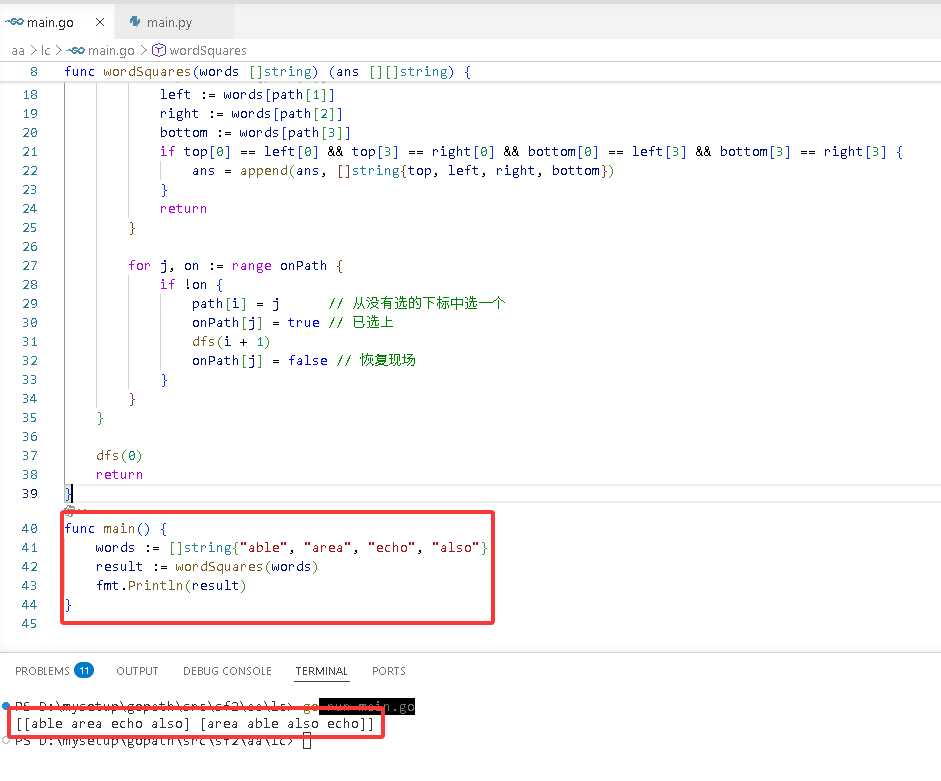
Python完整代码如下:
# -*-coding:utf-8-*-

from typing import List

def word_squares(words: List[str]) -> List[List[str]]:
    words.sort()  # 保证答案有序
    ans = []
    n = len(words)

    path = [0] * 4
    on_path = [False] * n

    def dfs(i: int):
        if i == 4:
            top = words[path[0]]
            left = words[path[1]]
            right = words[path[2]]
            bottom = words[path[3]]
            if (top[0] == left[0] and top[3] == right[0] and
                bottom[0] == left[3] and bottom[3] == right[3]):
                ans.append([top, left, right, bottom])
            return

        for j in range(n):
            if not on_path[j]:
                path[i] = j
                on_path[j] = True
                dfs(i + 1)
                on_path[j] = False

    dfs(0)
    return ans

if __name__ == "__main__":
    words = ["able", "area", "echo", "also"]
    result = word_squares(words)
    print(result)
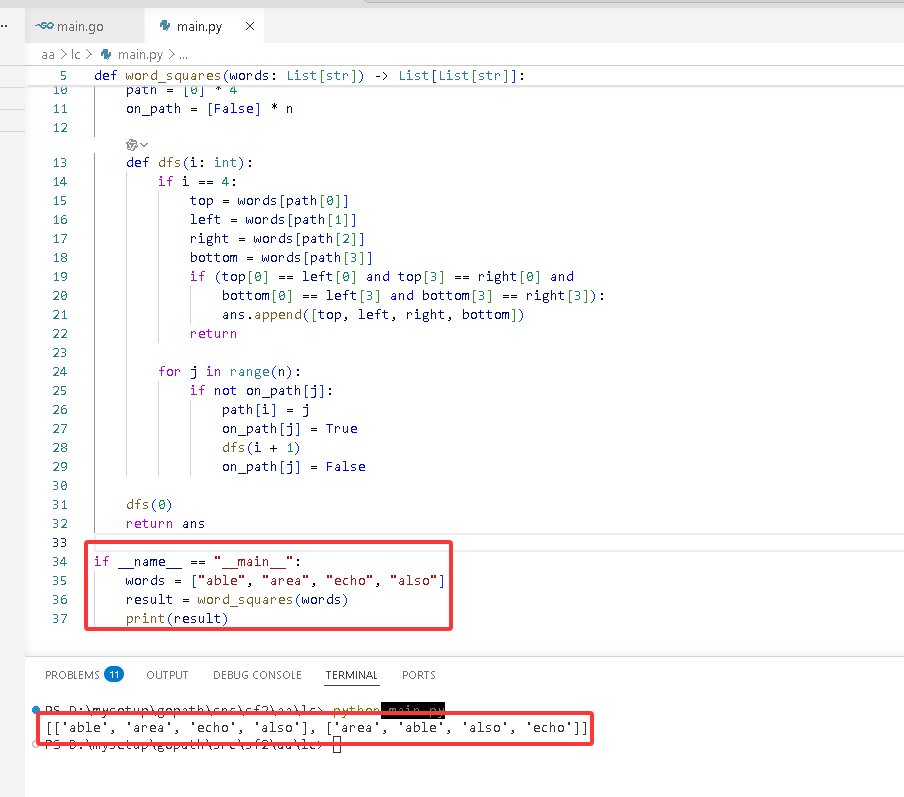
C++完整代码如下:
#include <iostream>
#include <vector>
#include <string>
#include <algorithm>

using namespace std;

void dfs(int i,
         vector<string>& words,
         vector<int>& path,
         vector<bool>& onPath,
         vector<vector<string>>& ans) {
    if (i == 4) {
        string top = words[path[0]];
        string left = words[path[1]];
        string right = words[path[2]];
        string bottom = words[path[3]];

        if (top[0] == left[0] &&
            top[3] == right[0] &&
            bottom[0] == left[3] &&
            bottom[3] == right[3]) {
            ans.push_back({top, left, right, bottom});
        }
        return;
    }

    for (int j = 0; j < words.size(); j++) {
        if (!onPath[j]) {
            path[i] = j;       // 从没有选的下标中选一个
            onPath[j] = true;  // 已选上
            dfs(i + 1, words, path, onPath, ans);
            onPath[j] = false; // 恢复现场
        }
    }
}

vector<vector<string>> wordSquares(vector<string>& words) {
    vector<vector<string>> ans;
    sort(words.begin(), words.end()); // 保证答案有序

    vector<int> path(4);
    vector<bool> onPath(words.size(), false);

    dfs(0, words, path, onPath, ans);
    return ans;
}

int main() {
    vector<string> words = {"able", "area", "echo", "also"};
    vector<vector<string>> result = wordSquares(words);

    for (const auto& square : result) {
        cout << "[";
        for (int i = 0; i < square.size(); i++) {
            cout << square[i];
            if (i != square.size() - 1) {
                cout << ", ";
            }
        }
        cout << "]" << endl;
    }

    return 0;
}
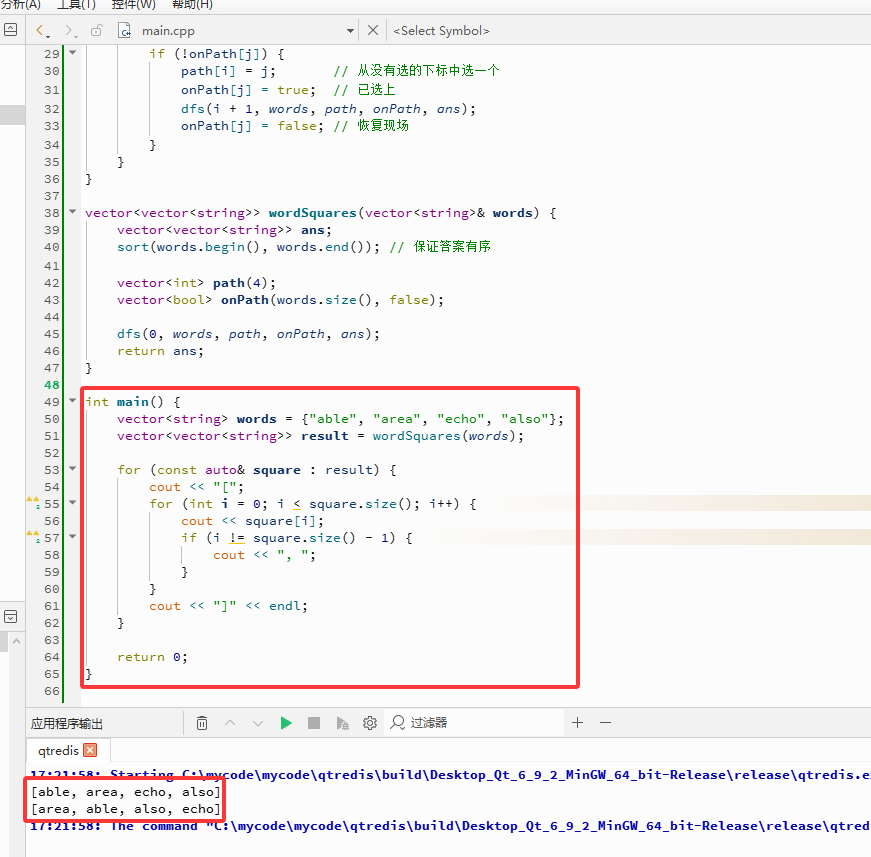

- 点赞
- 收藏
- 关注作者
评论(0)